Products
January 6, 2026
The LA-22 Low-Noise Laboratory Amplifier, 800 Hz–22 MHz, 1.1 nV / √Hz
One problem that comes up again and again in doing measurements is that we need the apparatus to be quieter than the thing we’re measuring, ideally by at least a factor of two. Besides quiet, it should be wideband, have an accurately known gain that’s flat with frequency, have a clean step response, and generally do its job while keeping itself out of the way. There’s a wealth of detail in our app note AN-1
on photoreceiver testing.
March 5, 2025
— updated December 30, 2025
In a previous article, we described an ultralow-cost time-domain reflectometer (TDR) that is used as a radar dipstick for fuel gauges in heavy equipment. Its 150-ps edges were better than good enough, and its rock-bottom BOM cost ($1.30 @ 100 pcs) made it possible for the whole gauge to retail for under $40. That performance is far from the limit for low-cost samplers, as we’ll see.
February 19, 2025
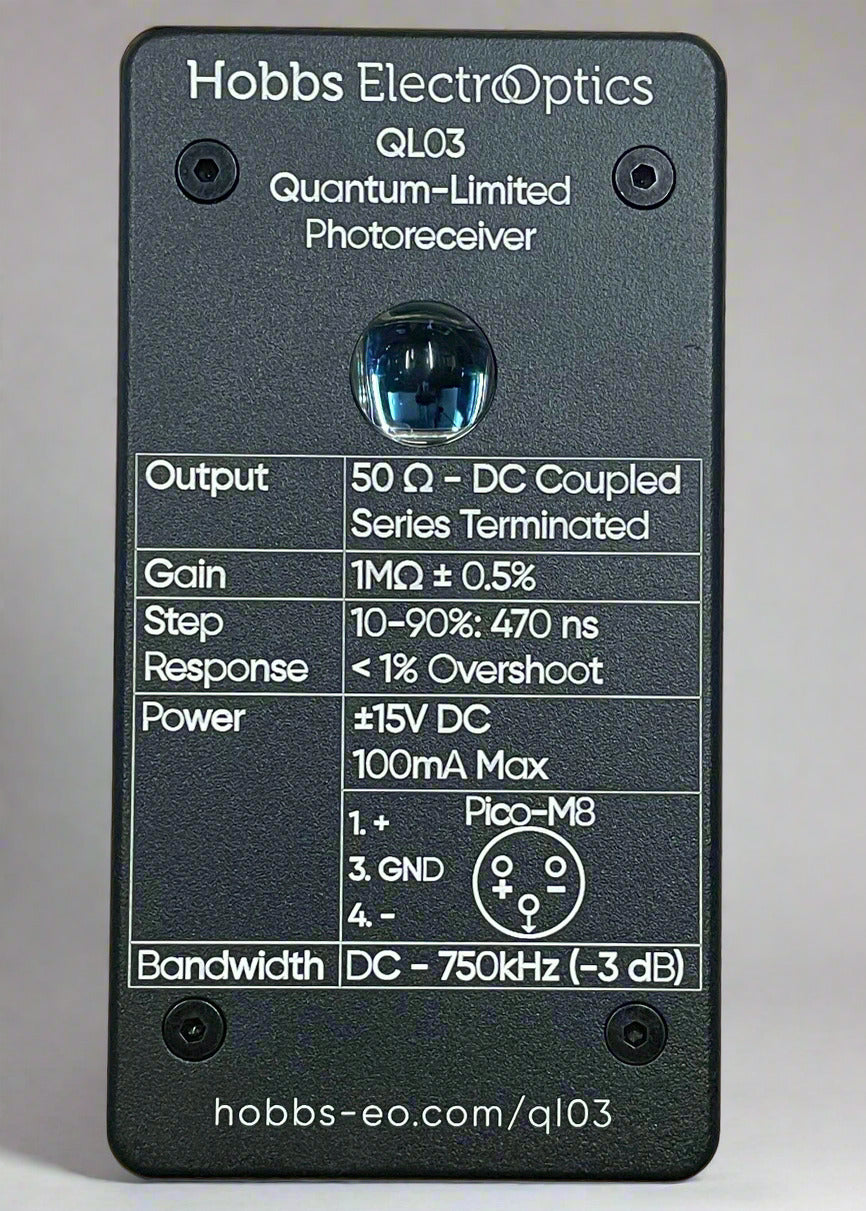
We’ve got a new photoreceiver available over at our sister site, Hobbs ElectroOptics. The QL03 Photoreceiver comes out of several proof-of-concept systems where we needed a high-sensitivity, low-noise optical receiver for low-light applications.
It features a massive 150 mm² photodiode with slight magnification from an immersion lens, making it especially effective for diffuse light measurements, spectroscopy, and fluorescence detection—plus, setup is a breeze since you’re aiming at a barn door.
January 25, 2021
— updated August 5, 2022
Internal Developments
In the last year or two we’ve been doing a lot of work aimed at replacing photomultiplier tubes (PMTs) in instruments, using avalanche photodiodes (APDs) and silicon photomultipliers (SiPMs). These devices are arrays of single-photon detectors, so they’re also known as multi-pixel photon counters (MPPCs). Our main application areas include biomedical instruments such as flow cytometers and microplate readers, which have to measure low light levels very precisely but don’t need the ultralow dark current of PMTs. (Follow-on articles will talk about our SiPM work in airborne lidar and SEM cathodoluminescence, as well as on improving the performance of actual PMTs.)