Expert Witness Cases
February 16, 2018
— updated January 20, 2022
This was a patent and trade secret case concerning lidar (laser radar) technology for self-driving cars and trucks. It was the biggest case I’ve worked on, with potential damages over $2 billion, and also one of the most fun. I was the defendant’s expert on the patent side, and we beat Google–they dropped all their patent assertions. (This was made a lot easier by the fact that Uber wasn’t infringing, of course.)
November 12, 2017
In the spring of 2017, I was approached by lawyers from two technology companies working in civil avionics (instruments for airplanes). I can’t say who they were due to NDA restrictions, but the job was an unusual and interesting one. The two companies had been joint development partners, but the relationship had soured and trust had now broken down completely. Both were concerned that the other was misusing intellectual property disclosed during the joint venture, and they asked me to do do an audit to see whether this was in fact true. The situation was made more complicated because one company was several hundred times as large as the other, and of course there was no court-ordered discovery and no one was under oath.
September 7, 2017
— updated January 20, 2022
Testifying defense expert representing Samsung in an action for patent infringement concerning optical storage, holographic optical elements, tracking servos, and signal integrity.
September 7, 2017
— updated February 17, 2018
This was another fun one with a lot of reverse engineering. This time round I was working with the plaintiff, Industrial Technology Research Institute, which is a research lab owned by the Taiwanese government. It was an action for patent infringement in the focusing and tracking servos of optical disc drives, as well as in the arrangement of the laser sources. The patent claims at issue concerned the way the magnetic “voice coil” actuators simultaneously adjusted focus, tracking, and tilt, so I needed to take several of the accused products apart and run the head servos by themselves in my lab. I also had to cut apart some of the coils to show how they were wired, and decap the lasers to show that there were two chips side-by-side in the CD/DVD source and one in the BluRay source.
September 7, 2017
— updated January 19, 2022
Testifying expert representing ThinkOptics in an action for patent infringement concerning video games, specifically the human interface of the Nintendo Wii.
February 15, 2015: Settled after an inter partes re-examination.
September 7, 2017
— updated May 15, 2025
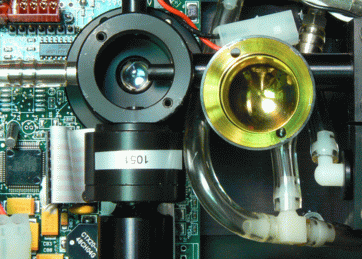
Particle counter showing gold mirror
This was quite an unusual situation. Dr. Aleksandr L. Yufa had several patents relating to optical particle counting, and tried to get various companies to license them. I don’t know if any actually signed up, but obviously some didn’t, because he sued several manufacturers and users of these technologies for infringement. The unusual part was that Dr. Yufa was acting pro se, that is, he was acting as his own lawyer.
September 7, 2017
— updated February 16, 2018
An interesting though brief patent interference case concerning flat-panel solar concentrators. The plaintiff (Morgan) had filed a continuation patent application, which is a means of getting additional claims out of a previously-filed specification. The new patent gets the same priority date as the old one, so you don’t have to worry about later art (such as that of the competitor whom you want to pay you royalties), but you don’t get the usual 20-year patent lifetime. Morgan then came after Banyan.
September 7, 2017
— updated February 17, 2018
It isn’t easy defending an IP lawsuit in the Eastern District of Texas.
This was a long-running case alleging patent infringement and trade secret misappropriation. Chipmaking company Intersil Inc. wanted to get into the market for ambient light sensors (ALS). An ALS is a tiny chip that goes into phones and other battery-powered devices, which lets the processor know how brightly lit the device’s surroundings are. That lets it adjust display brightness automatically to compensate, which saves battery power in dim surroundings and keeps the display from being too bright or too dim.
October 2, 2015
— updated January 18, 2020
Sometimes the expert has to tell the client that their case probably won’t hold up. This case was an excellent example: University of Cincinnati v. Crayola, Inc.
As happens so often, the defendant had petitioned for a reexamination of the asserted patent, and I was asked by the plaintiff to help out. The patent-in-suit was a division of an older case, so the specification had a lot of good inventive stuff in it, but the actual claims of this patent concerned ultraviolet-activated fluorescent displays (the black-light ones you see in bars and restaurants that you write on with a fluorescent marker). An interesting idea, for sure, but one that has been in wide use since the 1960s at least.
June 12, 2015
— updated November 12, 2017
January 2013 - June 2015.
Here I was a testifying expert working with the plaintiff in a case involving the fancy voice-coil electromagnetic actuators that control tracking and focus in optical disc drives (CD, DVD, BluRay). I did a lot of reverse engineering, including driving the actuators and taking video showing their operation, unwinding the coils to show their winding pattern and connections, that sort of thing. The case was stayed for quite awhile and then settled, so full reports and testimony weren’t required.
April 3, 2015
— updated November 12, 2017
November 2009 to March 2015
This was a very large ($100M) action for alleged patent infringement and trade secret misappropriation concerning ambient light sensor (ALS) chips. (These allow your phone to adjust the screen brightness to optimize readability and battery life.) I was testifying expert for the defendant on the trade secret side of the case, working with the late Dr. A. Bruce Buckman on the patent side. After an unsuccessful negotiation for Intersil to acquire TAOS, Intersil developed its own line of ALS chips. TAOS sued, alleging that these were based on TAOS intellectual property.
September 30, 2014
— updated November 12, 2017
January-September 2014
Sometimes you just get blindsided. Back in the mid-1960s, shortly after the laser was invented, a couple of smart guys named Norman Wild and Paul Leavy were working for a defense contractor in New Hampshire called Sanders Associates (now part of BAE Systems). They came up with a clever idea for spotting snipers on a battlefield, based on a laser and a special property of the eye. Most of us have seen the way a cat’s eyes seem to glow in the dark: their retinas are retroreflectors much like a bicycle reflector or a safety vest, that send light back preferentially the way it came. Human retinas do that too, though not quite as obviously. (Before smart digital cameras, photos taken with direct flash tended to show people’s eyes glowing bright red for this reason.)
January 10, 2013
— updated January 20, 2022
Testifying defense expert in an action for patent infringement concerning solid-immersion microscopy and laser voltage measurement in semiconductors.
Recent items:
- April 2012: Wrote claim construction declaration;
- May 1, 2012: Gave deposition in support of claim construction declaration;
- May 23, 2012: Assisted in tutorial
- December 2012: Case settled
January 5, 2012
— updated November 13, 2017
Testifying defense expert in an action for patent infringement in GBIC optical transceivers. Advised and performed some reverse engineering.
(settled quickly in 2011)
September 7, 2011
— updated January 19, 2022
March-June, 2009.
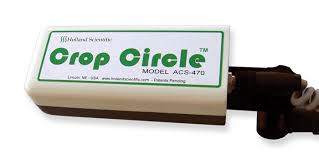
Holland ACS470
This was my first expert case, beginning shortly after I left IBM. It was a patent infringement case concerning real-time spectroscopic optical sensors for precision agriculture, i.e. finding the condition of each plant or small region of a field, and applying just the right amount of fertilizer or pesticide. Precision agriculture is a win all round; it improves crop yields, prevents the spread of pests, while reducing the cost of chemicals and minimizing the runoff of those chemicals into waterways and ground water.