March 9, 2018
— updated July 16, 2020
Measuring temperature is surprisingly subtle. There are lots of sensors out there; Digikey sells thermistor sensors interchangeable to +- 0.1 C from several vendors for about $3 in onesies. IC sensors tout good accuracy and linearity, and come in both analogue and digital versions for way under a buck. So what’s the issue?
The issue is: temperature sensors measure the temperature of the sensor, whereas what we want is the temperature of something else: air, fluid, or some solid object we’re trying to control. So the problem is to get the sensor temperature to track the temperature we actually care about. IC sensors are especially bad, because they have stout leads made of copper (400 W/m/K thermal conductivity) and small packages made of plastic (0.1 W/m/K). Thus they basically measure the temperature of their leads, and are horrible at measuring air temperature, for instance.
Read more…February 24, 2018
— updated January 20, 2022
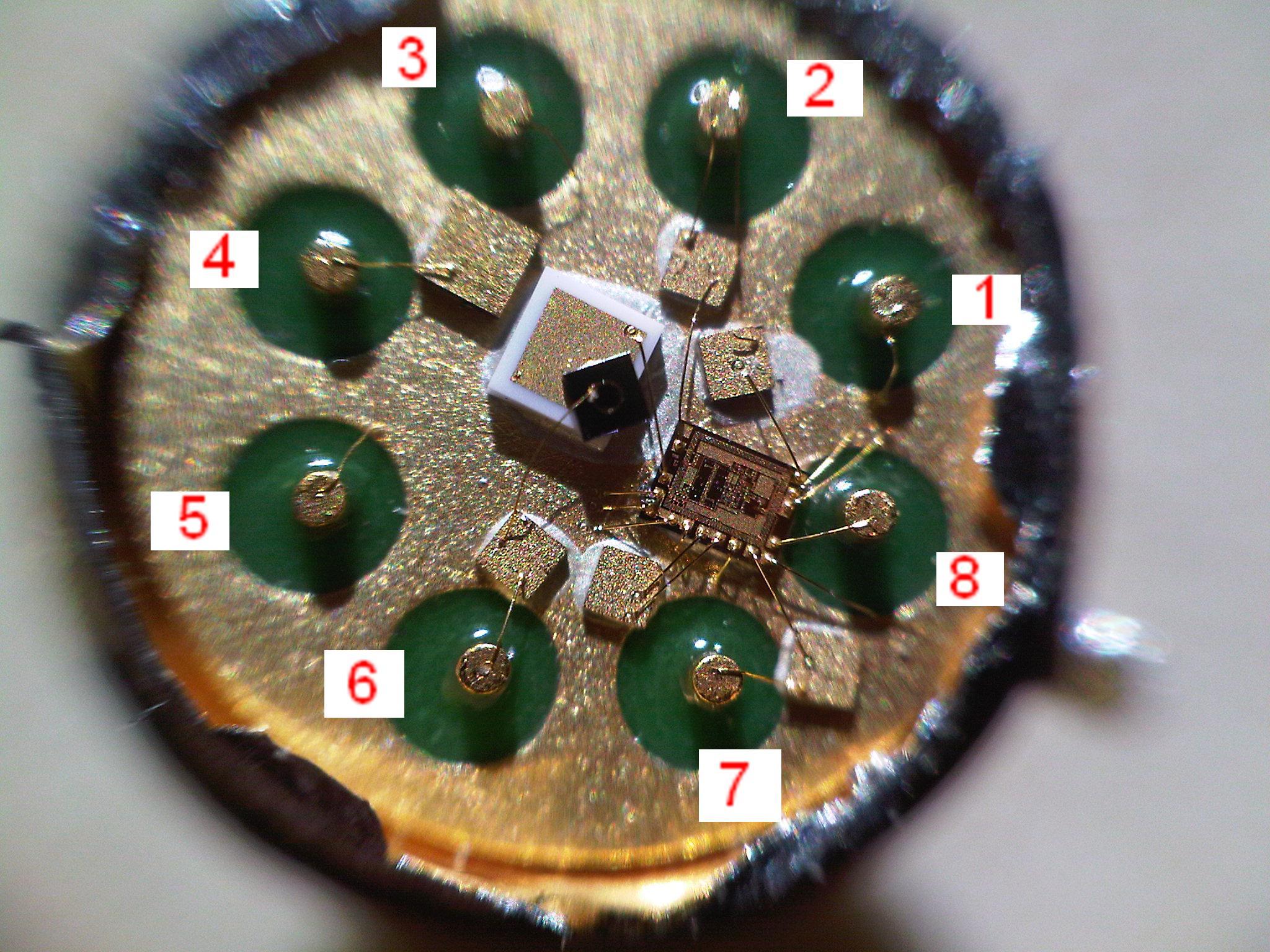
Decap picture of a Terabeam CD3109 APD/TIA module, taken with a lens glued to a cell
phone camera
Read more…February 24, 2018
— updated January 20, 2022
This odd circuit is an on-chip temperature balancer that uses thermal runaway to force N transistor arrays to all run at the same temperature. BJT dissipation goes up at low temperature, with very high gain. Here’s its step response.
Read more…February 24, 2018
— updated January 20, 2022
Sine wave generation is a perennial problem.
Direct-digital synthesis (DDS) uses a bunch of counters, lookup tables, and DACs,
but that’s a relatively heavyweight solution that doesn’t fit all problems.
BJT differential pairs naturally have a hyperbolic tangent (tanh) characteristic, which can be used to round off a triangle wave into a very passable sine. I’m not old enough to have invented this technique, but here are a couple of illustrations of how it works: TANH Sine Wave Shaper (PDF) and TANH Sine Wave Shaper (Mathcad).
Read more…February 24, 2018
— updated January 20, 2022
Solid tantalum capacitors have a lot of advantages: very low inductance in surface mount packages, ESR low but not so low that your LDO regulators start oscillating; and good capacitance per unit volume. Unfortunately they’re also prone to burn up when mistreated, which makes many engineers wary of them. This war story, entitled What a Cap-astrophe! talks about how to treat them properly, and how a bit of TLC after soldering can restore their full performance.
Read more…