A case I’ve been working on since March 2012, DCG Systems v Checkpoint Technologies, has settled, and I’ve been retained in two others, ThinkOptics v Nintendo et al. (helping ThinkOptics with an inter partes reexamination), and Voxpath RS v Desay et al. (defending Samsung in an optical disc case).
I’m designing two brand new front ends for a scanning surface voltage tool for semiconductor manufacturing. Normally there are two ways you can measure surface potential—the vibrating Kelvin probe, which gets you the actual voltage but is very slow, or the fast-scan method, which is fast but gets you only the 1-D derivative of the potential.
Working with a leading semiconductor tool vendor, I’ve come up with both an improved transimpedance front end and (more interestingly) a new class of front end amplifiers that should be able to get the actual voltage like the Kelvin probe while going fast like the scanning method, while providing at least 15 dB SNR improvement over either one.
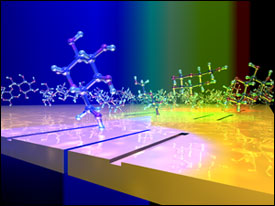
(We can’t show ours due to NDA requirements– this is a cool one from Brown University that uses plasmonics.)
We’ve just started a collaboration with a prominent biotech company in California on spectroscopic-detection biochips using photonic waveguides. Our part of the effort is to explore the design space and come up with new topologies to maximize signal-to-noise ratio and measurement stability. This is an excellent application for POEMS as well as being an exciting new area for us.
Testifying defense expert in an action for patent infringement in GBIC optical transceivers. Advised and performed some reverse engineering. (settled quickly in 2011)
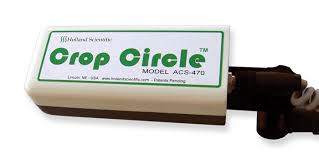
This was my first expert case, beginning shortly after I left IBM. It was a patent infringement case concerning real-time spectroscopic optical sensors for precision agriculture, i.e. finding the condition of each plant or small region of a field, and applying just the right amount of fertilizer or pesticide. Precision agriculture is a win all round; it improves crop yields, prevents the spread of pests, while reducing the cost of chemicals and minimizing the runoff of those chemicals into waterways and ground water.