I’m testifying in my first trial, as an expert witness on the trade secret side of a complicated lawsuit alleging patent infringement, trade secret misappropriation, among other things. As a technical expert, I have to sit through the whole three-week trial to make sure I don’t miss any relevant testimony, even though I’ll probably be on the stand for no more than three or four hours. It’s actually pretty interesting.
Coherent laser radar (often miscalled lidar) is an ultrasensitive method for measurement of distance and radial velocity. It uses low power CW lasers and has excellent resistance to ambient light and interference from other laser radars. I’m doing a design for a unit suitable for vehicles and small ships (e.g. tugboats).
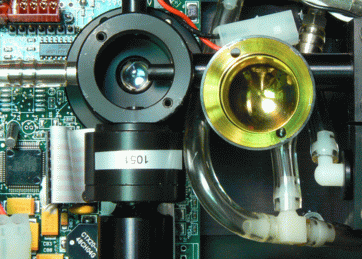
This is a very exciting development, in cooperation with a semiconductor equipment manufacturer, I’m building a visible-light scanning microscope with six times higher lateral resolution than is possible with a normal microscope. It’s based on my Ph.D. thesis work and some things I did at IBM long ago.
Sometimes you just get blindsided. Back in the mid-1960s, shortly after the laser was invented, a couple of smart guys named Norman Wild and Paul Leavy were working for a defense contractor in New Hampshire called Sanders Associates (now part of BAE Systems). They came up with a clever idea for spotting snipers on a battlefield, based on a laser and a special property of the eye. Most of us have seen the way a cat’s eyes seem to glow in the dark: their retinas are retroreflectors much like a bicycle reflector or a safety vest, that send light back preferentially the way it came. Human retinas do that too, though not quite as obviously. (Before smart digital cameras, photos taken with direct flash tended to show people’s eyes glowing bright red for this reason.)
Based in large part on my expert reports and reverse engineering of accused products, our Motion for Summary Judgment was granted. In the order, Judge Beverly O’Connell stated that the defendant “…has shown that Plaintiff has failed to produce evidence to support his claims for patent infringement.”
This is especially satisfying to me, since although I had been retained only in September, the case had been dragging on for over six years, and a previous motion for summary judgment had been denied. (The only drawback is that I had been looking forward to testifying in January.)