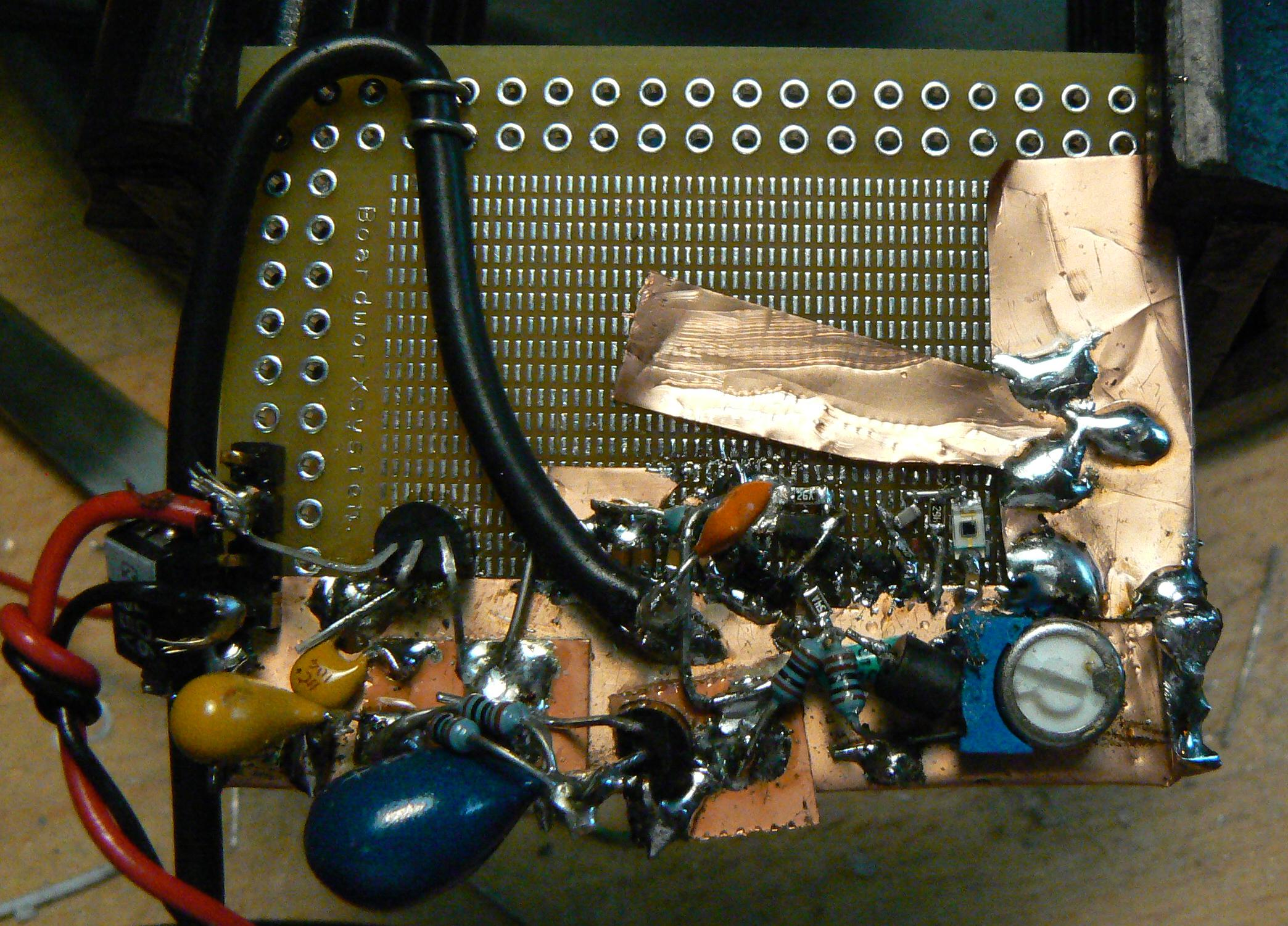
This is pretty small, because it has to be–those are microwave transistors, and will oscillate at the slightest provocation. The axial resistors and TO-92 parts are all for biasing—the actual amplifier is the part between the output coupling cap (the small orange thing in the middle) and the photodiode, which is the white square with the black middle at the right.
The 0.1-inch pitch holes round the outside and 25-mil pad pitch set the scale.
As discussed in medium-gory detail in this paper, laser noise cancellers can let you do shot-noise limited measurements at baseband with lasers that are as much as 70 dB noisier than that.
They’re limited by two main effects: beta nonlinearity (1/hFE-1/hfe) and log nonconformance (d ln(IC)/dVBE - kT/e).
This tester measures both of these quantities directly. It’s a one-off, of course, so it’s done with discrete logic and instrumentation amp parts. It has certain points of interest, for instance the use of a unity gain instrumentation amplifier as a precision +1/+2 gain amplifier. One loose end: U1 is a LT1043 switched-capacitor building block—a glorified MUX that has very low charge injection and very good common-mode rejection.
Sometimes the expert has to tell the client that their case probably won’t hold up. This case was an excellent example: University of Cincinnati v. Crayola, Inc.
As happens so often, the defendant had petitioned for a reexamination of the asserted patent, and I was asked by the plaintiff to help out. The patent-in-suit was a division of an older case, so the specification had a lot of good inventive stuff in it, but the actual claims of this patent concerned ultraviolet-activated fluorescent displays (the black-light ones you see in bars and restaurants that you write on with a fluorescent marker). An interesting idea, for sure, but one that has been in wide use since the 1960s at least.
Here I was a testifying expert working with the plaintiff in a case involving the fancy voice-coil electromagnetic actuators that control tracking and focus in optical disc drives (CD, DVD, BluRay). I did a lot of reverse engineering, including driving the actuators and taking video showing their operation, unwinding the coils to show their winding pattern and connections, that sort of thing. The case was stayed for quite awhile and then settled, so full reports and testimony weren’t required.
This was a very large ($100M) action for alleged patent infringement and trade secret misappropriation concerning ambient light sensor (ALS) chips. (These allow your phone to adjust the screen brightness to optimize readability and battery life.) I was testifying expert for the defendant on the trade secret side of the case, working with the late Dr. A. Bruce Buckman on the patent side. After an unsuccessful negotiation for Intersil to acquire TAOS, Intersil developed its own line of ALS chips. TAOS sued, alleging that these were based on TAOS intellectual property.